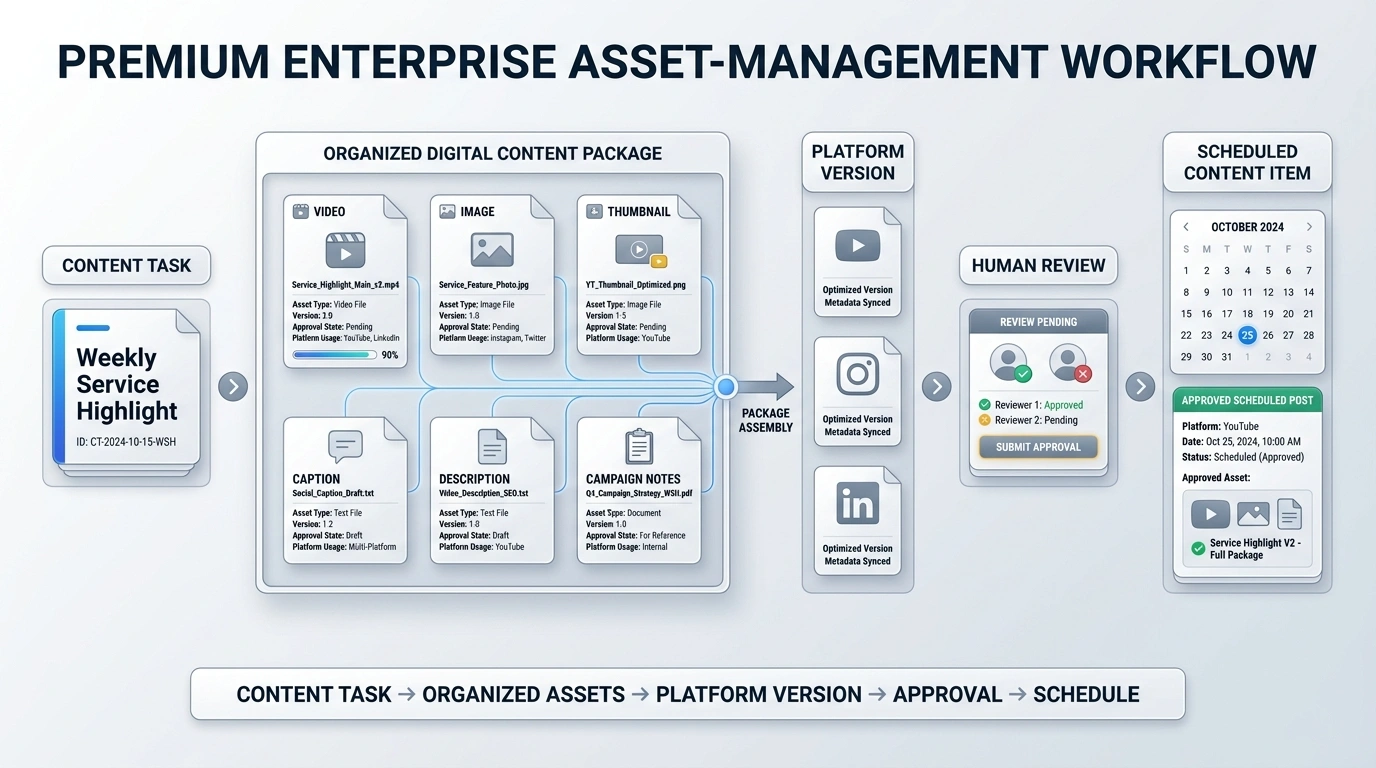
Content Planning
Organize briefs, source material, campaign notes, and recurring content tasks in a visible queue.
Controlled Social Media Workflow Agents
ASFIT Solutions develops controlled social media automation systems that can organize recurring content preparation, platform-specific drafts, assets, approval stages, supported publishing actions, and content-status tracking.
SOCIAL CONTENT WORKFLOWConfigured platform branches
Content Operations
A controlled system can organize recurring workflow steps and reduce repetitive coordination while public-facing content decisions and approvals remain with authorized staff where required.
Organize briefs, source material, campaign notes, and recurring content tasks in a visible queue.
Prepare channel-specific variants according to configured formats, metadata, and workflow rules.
Route selected public-facing content through configured human review and editorial decisions.
Coordinate approved schedules and supported publishing actions without assuming every platform permits direct publishing.
Scope & governance: The workflow supports recurring content operations within agreed channels, permissions, platform capabilities, and human-control requirements.
Target Content Operations
Select a content operating environment to review where a structured workflow may help.
Teams managing recurring content releases that need organized brief intake, asset coordination, platform variants, review, and scheduling.
Internal teams coordinating campaigns, content calendars, approvals, and supported channel actions across recurring publishing work.
Agencies managing distinct client assets, brand requirements, review paths, and publishing schedules across approved channels.
Brands preparing product, campaign, and educational content that needs platform-specific formatting and controlled approval.
Businesses organizing service updates, guidance, announcements, and customer-facing content through repeatable review stages.
Teams that need clear separation between brand assets, content queues, reviewer responsibilities, and publishing calendars.
Teams responsible for moving content from brief and assets through preparation, review, scheduling, and recorded completion.
Organizations adapting approved source content for several supported channels without treating every platform as identical.
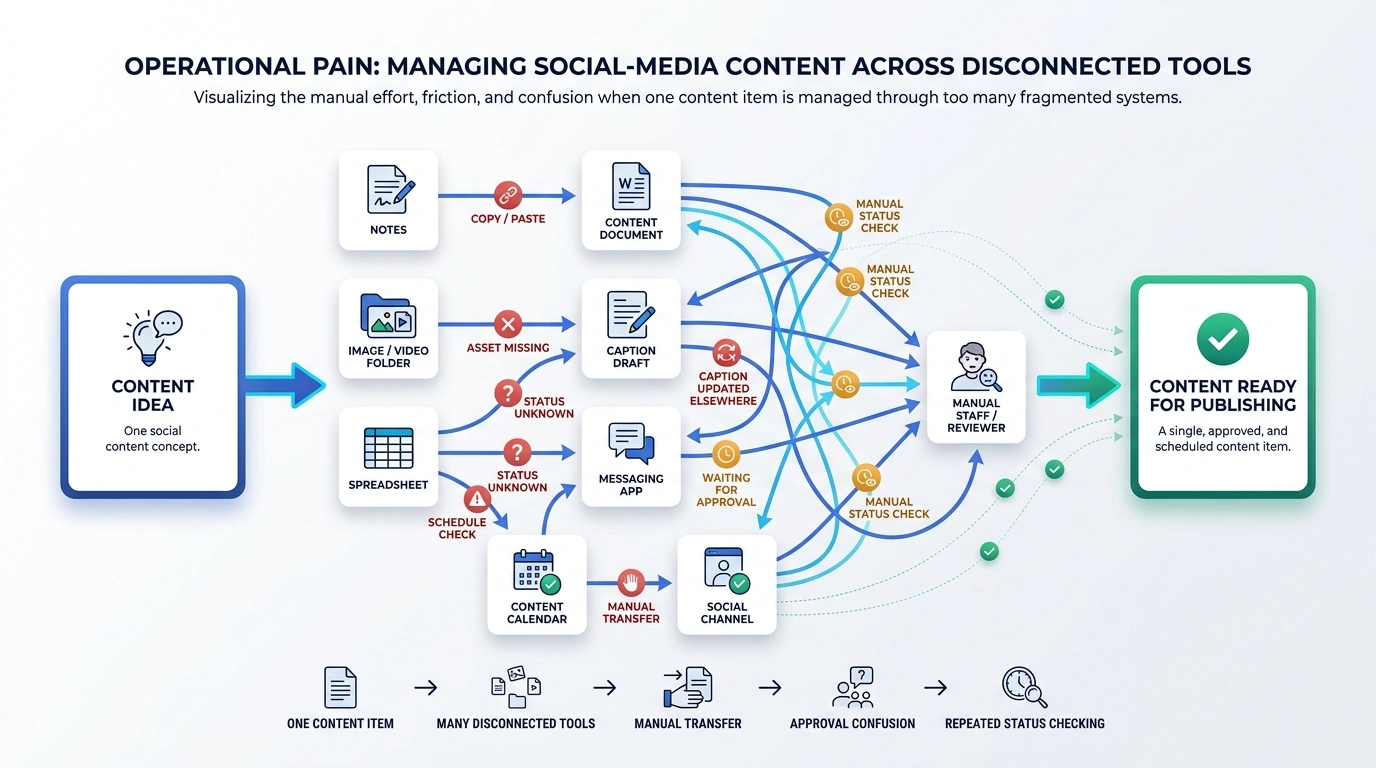
Content Fragmentation
A single content item can become difficult to manage when briefs, assets, platform versions, review, and scheduling move through disconnected tools.
Workflow Comparison
A qualitative comparison between fragmented manual coordination and a controlled, visible content workflow.
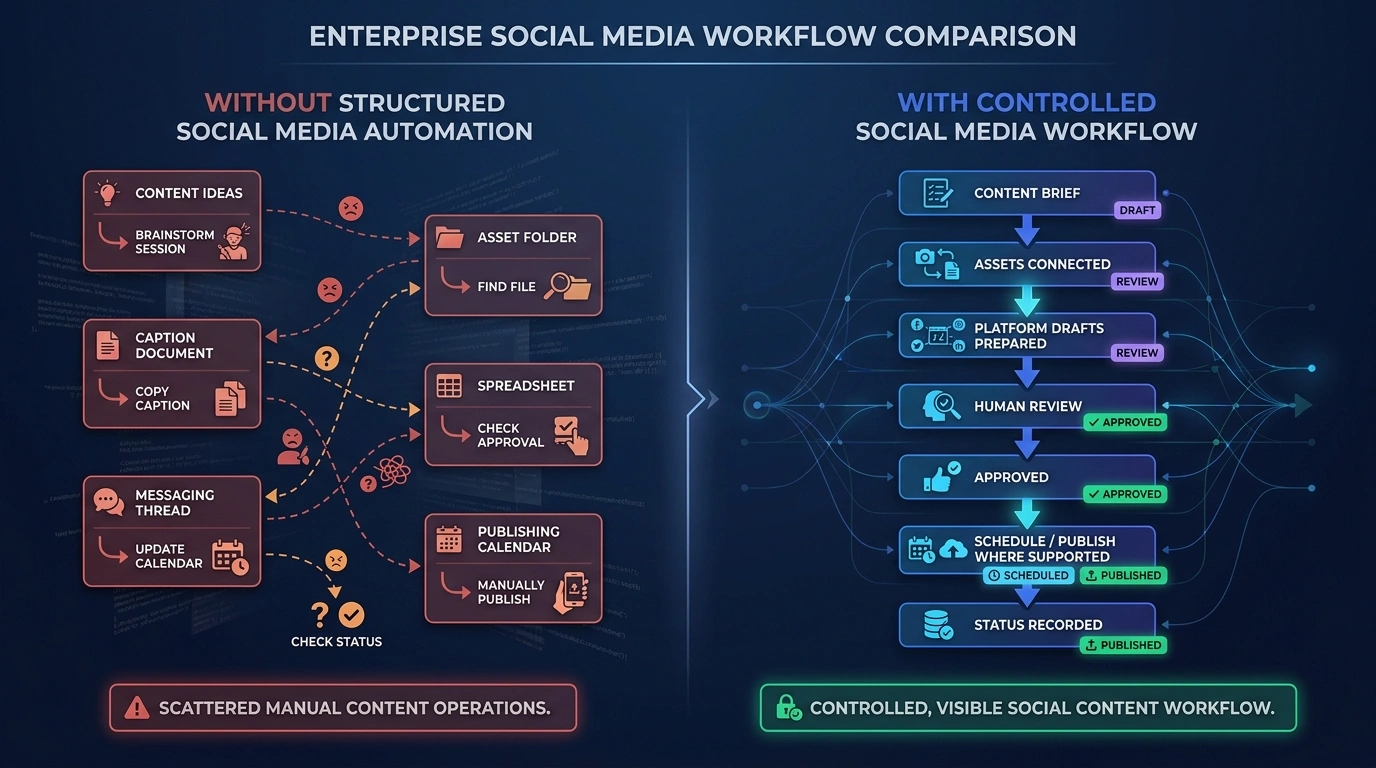
Without Structured Automation
With a Controlled Social Workflow
Modular Capabilities
Capabilities are selected around the content process, supported channels, authorized access, and agreed project scope.
Structured intake for campaign objectives, source topics, brand notes, and creative requirements.
A centralized backlog can organize upcoming items, priority, ownership, and target dates.
Initial draft copy can be prepared from approved briefs, source material, and voice guidance.
Text, metadata, calls to action, and media requirements can be adapted by supported channel.
Configured tags, categories, descriptions, and link parameters can be prepared where relevant.
Approved videos, images, thumbnails, captions, and notes can stay attached to one content record.
A visual calendar can show planned, review, approved, scheduled, and recorded publishing states.
Selected public content can pause for reviewers to approve, edit, reject, or request changes.
Approved release dates can be coordinated through supported tools and authorized connections.
Supported publishing actions can use authorized platform or API connections where available.
Recorded states can follow content from brief and draft through review, scheduling, and completion.
A structured timestamped activity history can record relevant workflow actions where included.
Available capabilities depend on project requirements, supported platforms, authorized permissions, API availability, and agreed scope.
Content Lifecycle
An eight-stage path from an approved content brief to a recorded scheduling or publishing outcome.
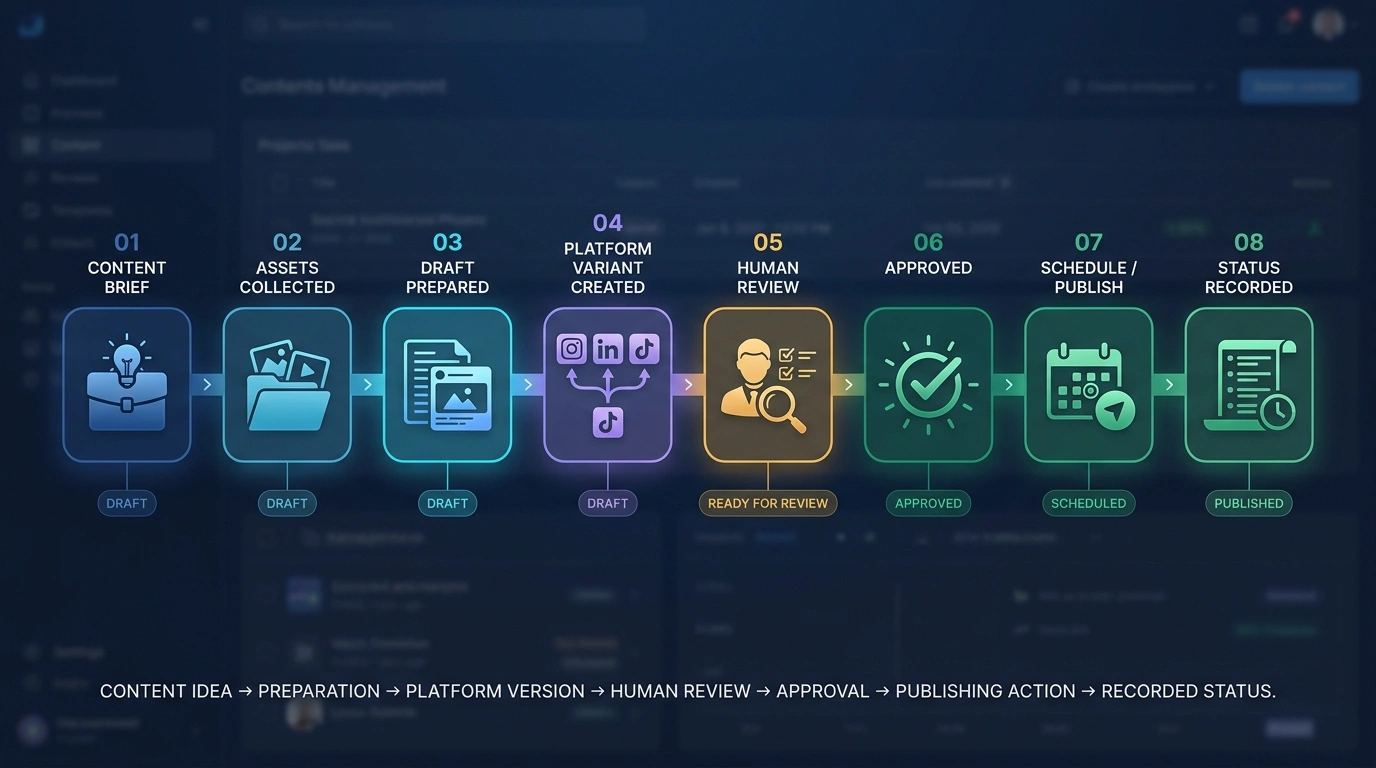
Content Visibility
A structured workspace can provide clear visibility into current recorded content states, linked assets, reviewer decisions, and scheduling status.
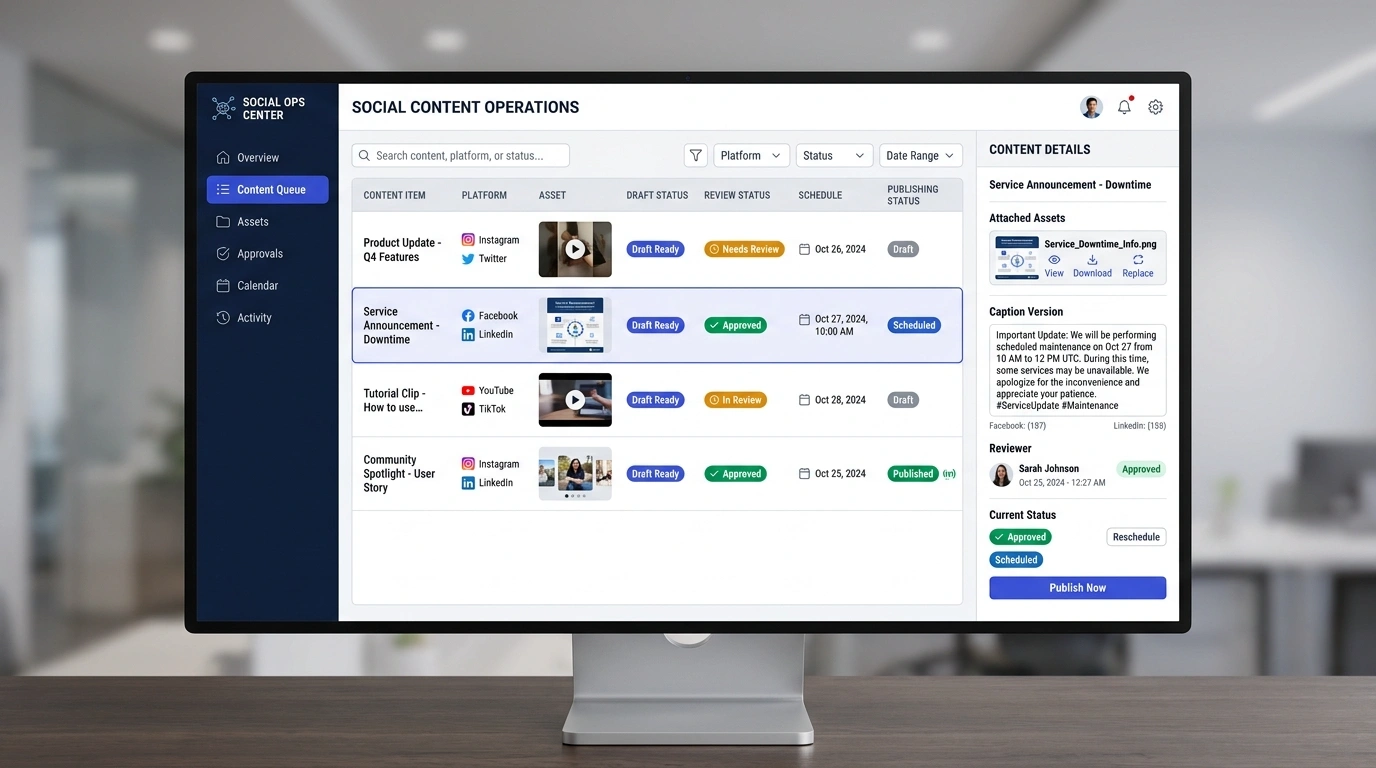
Topic, campaign, ownership, selected assets, and intended channels.
Recorded states showing whether content is drafting, awaiting review, or approved.
Linked videos, images, thumbnails, captions, and descriptions in one content record.
Planned dates, supported channel actions, staff confirmations, and recorded status.

Platform Preparation
One approved source package can be adapted into channel-specific drafts according to configured platform requirements and workflow rules.
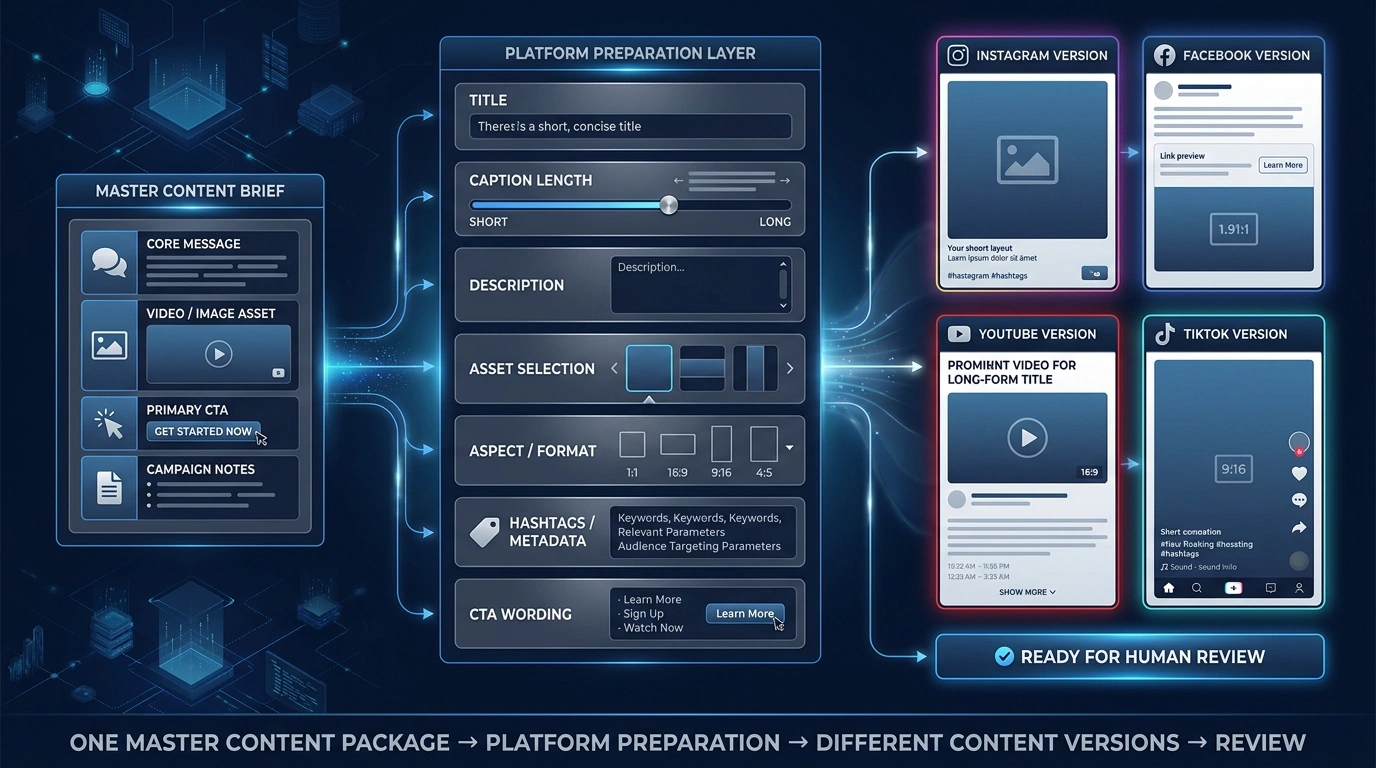
Configured caption structure, media format, metadata, and call-to-action wording.
A channel-specific post variant using approved text, links, assets, and formatting rules.
Supported title, description, thumbnail, metadata, and video-format preparation.
A vertical-content variant with configured caption, media, metadata, and review requirements.


Content Assets
A content record can keep approved media, copy, campaign notes, platform versions, review decisions, and scheduling details together.
Human Control
Where configured, selected public-facing content pauses for staff review before any supported publishing action proceeds.
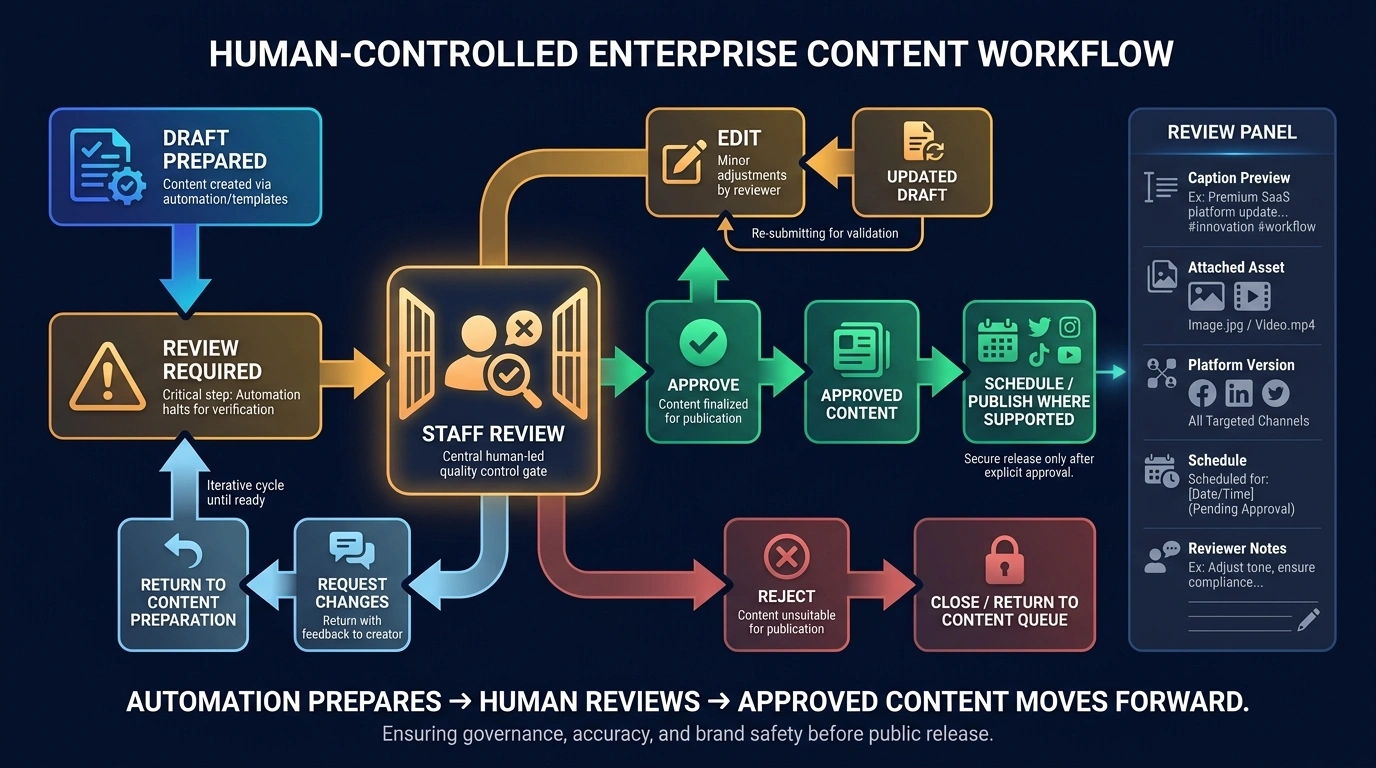
Release approved content to the next configured workflow stage.
Adjust copy, metadata, assets, or platform-specific preparation.
Return the item to content preparation with reviewer notes.
Close the item or return it to the content queue without publishing.
Publishing Coordination
Approved content can move through supported direct publishing or staff-confirmed release paths according to platform capability and workflow policy.
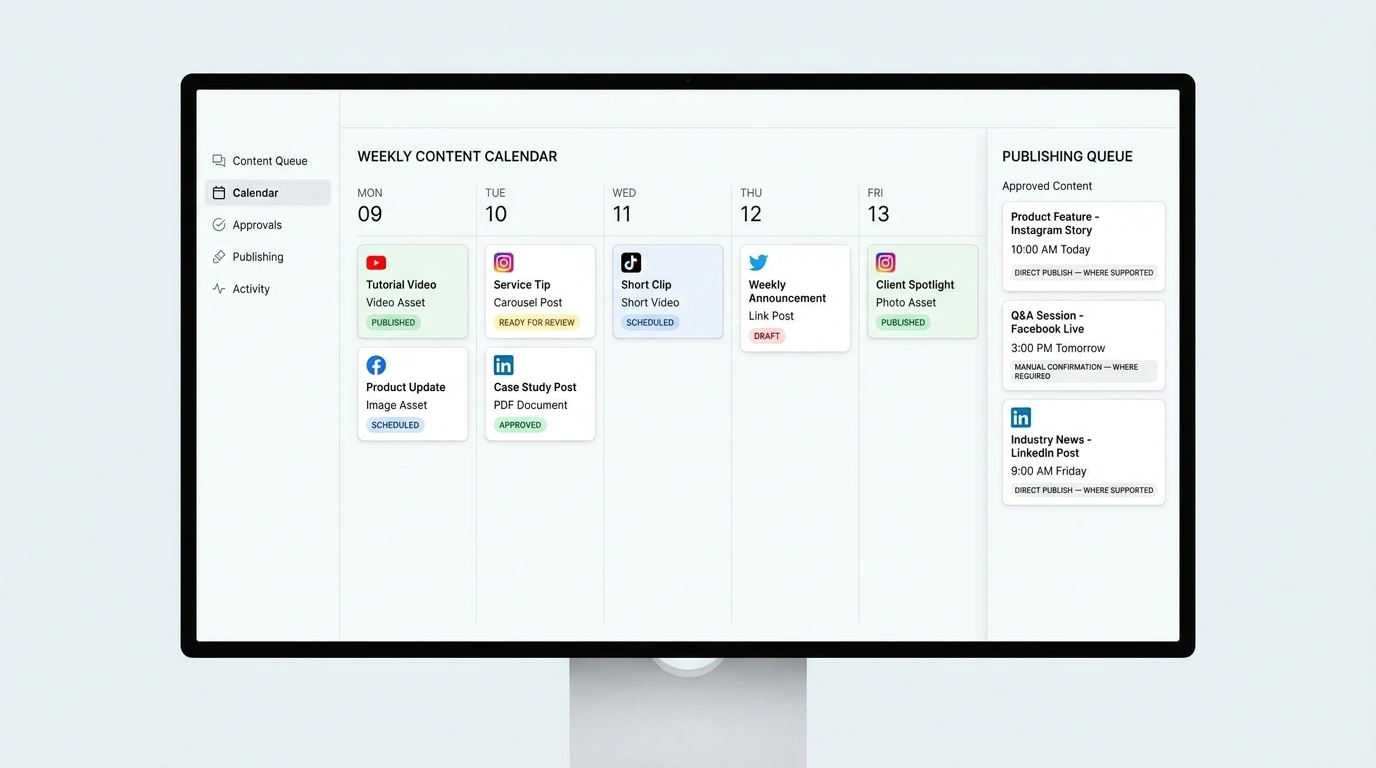
Where official platform APIs, permissions, credentials, and supported capabilities permit.
Where direct publishing is unavailable or workflow policy requires an authorized staff action.
Draft, Ready for Review, Approved, Scheduled, Published.
Platform scope: Publishing actions depend on platform support, authorized account permissions, API availability, and agreed project scope.

Methodology
A structured process for designing, testing, and refining a controlled content-operations workflow.
Review current channels, content cadence, team handoffs, assets, approvals, and recurring bottlenecks.
Define brief intake, asset preparation, platform adaptation, review, scheduling, and status-recording steps.
Confirm supported platforms, account permissions, authentication methods, API availability, and publishing constraints.
Design controlled preparation, routing, approval, fallback, and publishing-assistance behavior.
Implement agreed queues, content states, platform variants, review gates, and supported connections.
Test content states, permission boundaries, reviewer actions, platform responses, and fallback paths.
Release the approved workflow, monitor practical use, and refine agreed rules and integrations.
Engineering Foundations
Business-friendly controls for authorized access, platform constraints, approval, workflow state, and supported publishing actions.
Preparation and publishing actions stay within agreed channels, content types, and workflow boundaries.
Account connections use supported authentication methods and platform permissions.
Actions remain limited to the capabilities authorized for each supported channel.
Selected public-facing content can require authorized editorial review before proceeding.
Recorded workflow states can identify draft, review, approval, scheduling, and completion.
Structured workflow activity records can be included for relevant actions and decisions.
Failed requests and unavailable connections can follow configured retry, stop, or staff-review paths.
Workflow design respects available API limits and handles relevant rate-limit responses appropriately.
Prepared content can move to manual confirmation when a supported direct action is unavailable.
Workflows use agreed platform requirements at implementation time and can be reviewed when requirements change.
Ecosystem Connectivity
Compatible business content systems and supported social channels can participate through authorized connections and agreed workflow boundaries.
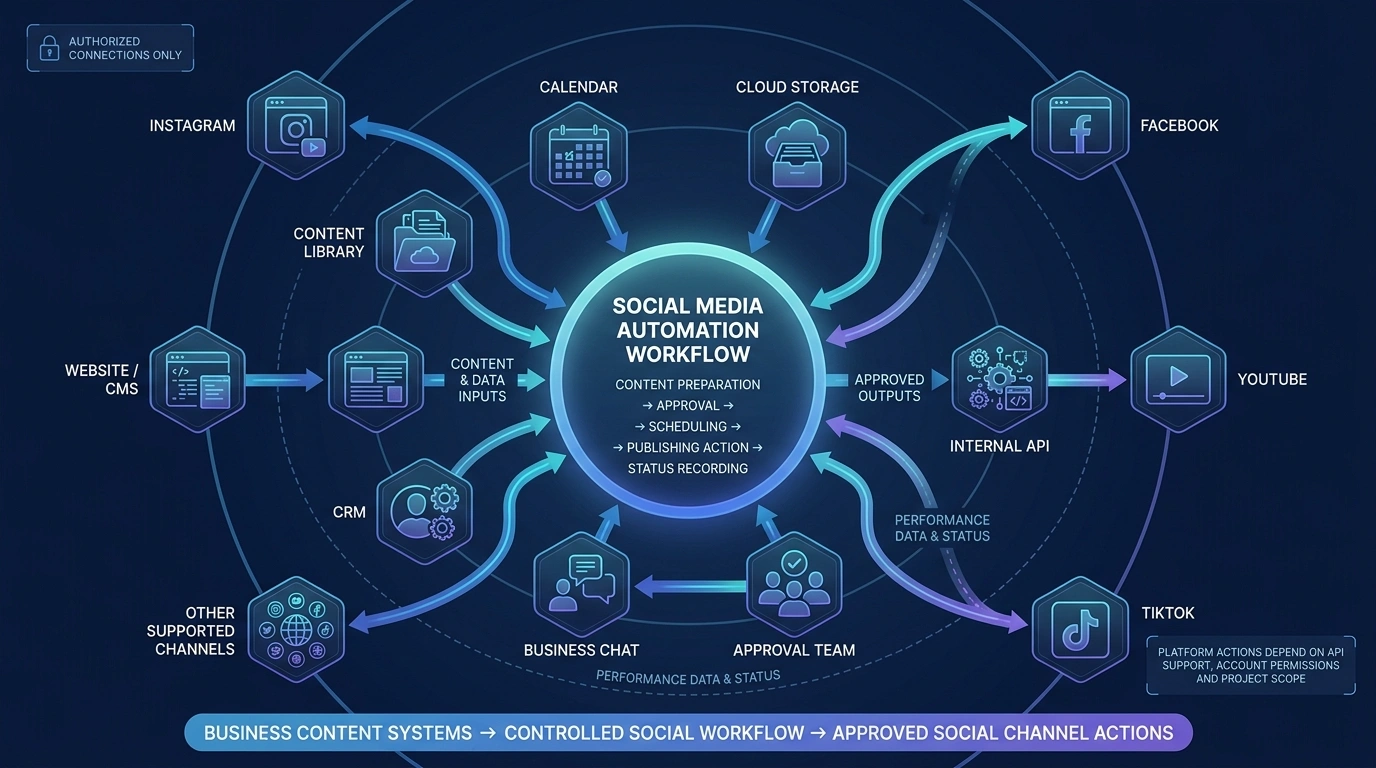
Available connections and publishing actions depend on platform support, authorized permissions, API availability, and project scope.
Qualitative Improvements
Qualitative workflow changes that can follow when recurring content preparation, review, and publishing coordination are organized around visible states.
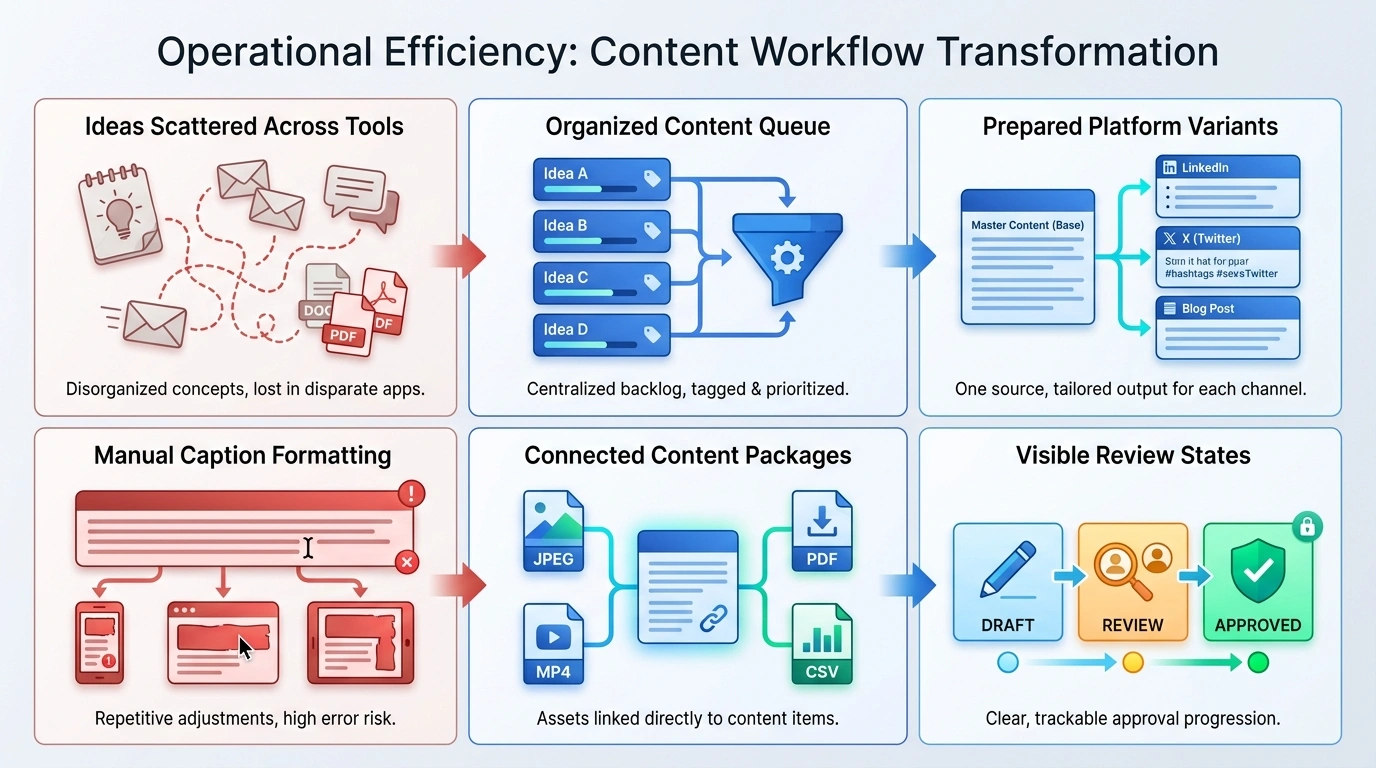
From: Ideas scattered across tools
To: Organized content queue
From: Repeated manual caption formatting
To: Prepared platform variants
From: Assets separated from publishing tasks
To: Connected content packages
From: Unclear approval status
To: Visible review states
From: Repeated scheduling checks
To: Structured publishing calendar
From: Scattered publishing history
To: Recorded content activity
Complementary Capabilities
Connect content operations with controlled agents, business workflows, customer systems, and communication tools.
Coordinate defined specialist task roles, dependencies, approved tools, and review points around complex objectives.
Explore Service →Build a controlled agent for agreed objectives, approved context, connected actions, and human oversight.
Explore Service →Connect recurring business workflows, data movement, decisions, and staff approval stages.
Explore Service →Create a business chatbot around approved knowledge, defined conversations, and supported handoffs.
Explore Service →Centralize customer records, workflow status, responsibilities, and operational reporting.
Explore Service →Support internal or customer communication through secure, purpose-built chat workflows.
Explore Service →Questions & Answers
Yes, where included. A workflow can prepare separate variants for supported platforms according to configured requirements such as caption structure, title, description, media format, metadata, and call-to-action wording.
Direct publishing depends on supported platform APIs, account permissions, authorization, available capabilities, and agreed project scope. Where direct publishing is unavailable or unsuitable, the workflow can prepare an approved package for staff confirmation.
Yes. Workflows can require selected public-facing content to pause for an authorized reviewer who can approve, edit, request changes, or reject it before any supported publishing action continues.
Yes, where included. Platform variants can use configured requirements for caption length, structure, hashtags, metadata, descriptions, and calls to action, with staff review where required.
A content task can reference approved images, videos, thumbnails, captions, descriptions, and campaign notes so the correct content package stays connected through preparation, review, and scheduling.
A project can include a content calendar with recorded states such as draft, ready for review, approved, scheduled, and published, subject to the systems and integrations included.
Supported content libraries, websites, calendars, cloud storage, CRM systems, business chat, internal APIs, and social channels may be connected when compatible access and permissions are available.
No. This service does not guarantee followers, reach, engagement, virality, revenue, or sales. It focuses on creating a clearer, controlled content-operations workflow.
Share your current content process, channels, assets, approval roles, publishing requirements, supported tools, and the recurring coordination problems you want to address. ASFIT will assess a practical controlled scope.
Start Your Social Media Automation Project
Share your content process, supported channels, assets, review stages, and publishing requirements. ASFIT Solutions can assess a controlled workflow around your team and platform constraints.
It is a controlled software workflow that can organize recurring content operations such as brief intake, asset coordination, platform-specific preparation, review, scheduling, supported publishing actions, and status recording.